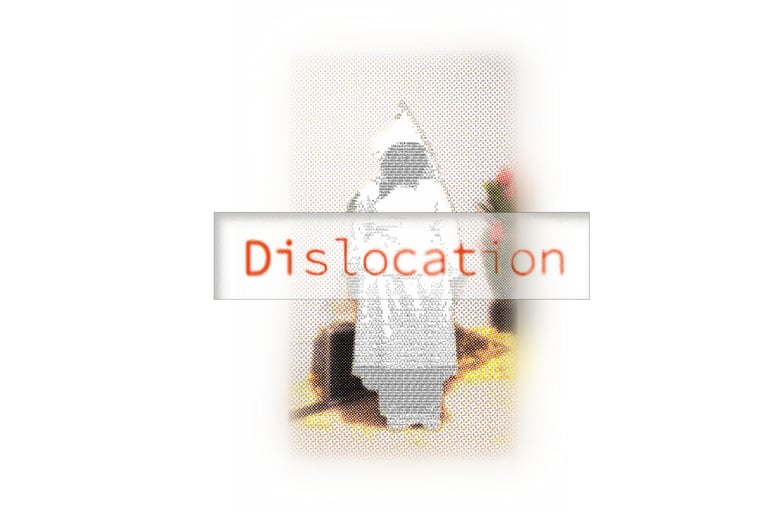
This photographic series centers on the concept of "displacement." Originating from an existentialist vantage point, it scrutinizes the contemporary "subject" amidst the disintegration of spatio-temporal order, the encroaching homogenization of the environment, and the consequent erosion of existential significance—all viewed through the prism of Marc Augé’s "non-places" and the relentless momentum of high modernity.
My photography serves as a mirror to the interior, exploring how the individual descends into a state of "suspension": a condition of being unable to return to the past, yet equally incapable of integrating into the present. This sense of displacement does not stem from a lack of harmony within the world itself; rather, it arises from the human endeavor to comprehend a world that yields no answers. As Albert Camus observed: "The absurd is born of this confrontation between the human need and the unreasonable silence of the world".
While displacement often implies loss and suffering, it is noteworthy that humans appear inherently predisposed to struggle against their own bewilderment subconsciously. Though fate remains immutable, the possibility of redefining one’s existential presence persists.
Specifically, my research is profoundly inspired by Camus’ assertion that "the irrational, the human nostalgia, and the absurd that springs from their contact—these are the three characteristics of the human tragedy". From this perspective, this project attempts—perhaps subconsciously—to explore the manifestations of "nostalgia" and "longing" in the contemporary world, which I perceive, to an extent, as a form of mono no aware.
While there is likely no method to reconstruct or repair the past, one may attempt to locate the coordinates of the subject within a landscape to which return is impossible, thereby creating a silent depiction of reality. Echoing certain existentialist tenets—wherein the individual seeks to re-orient themselves through the very act of "observation" when the web of meaning unravels—this work represents a persistent struggle within a spiritual desert, driven by the yearning to establish a sanctum, a pure land, or a new "spiritual home". Consequently, photography—as a medium—becomes a surrogate language for the lost: it is both a testament to existential drifting and a gateway to a potentially renewed way of being.